Praxis AI decision systems and enterprise decision architecture

Decision Architecture

AI changes who decides, what escalates, and how accountability operates at scale.

Distributed Authority

Escalation, Oversight, Accountability

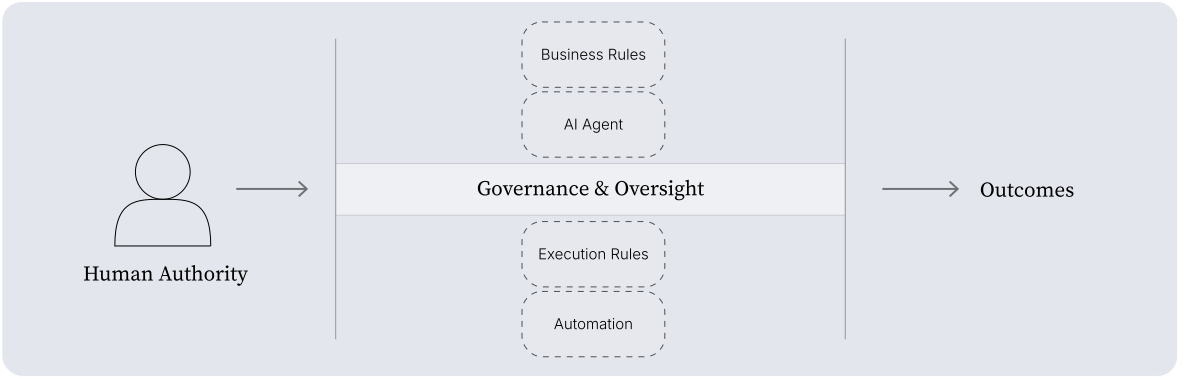
Decision architecture diagram showing human authority, governance and oversight, business rules, AI agents, execution rules, automation, and outcomes
AI changes how authority moves through organizations and across connected systems.

Actions that once required direct human coordination increasingly move through agents, workflows, and embedded automation.

As execution becomes more autonomous, organizations increasingly redefine:
  • who can act
  • what requires escalation
  • where intervention occurs
  • how accountability persists
  • which decisions remain reversible

Without clear operational structures, autonomy expands faster than governance can adapt.
Escalation & Reversibility

Autonomy Requires Boundaries

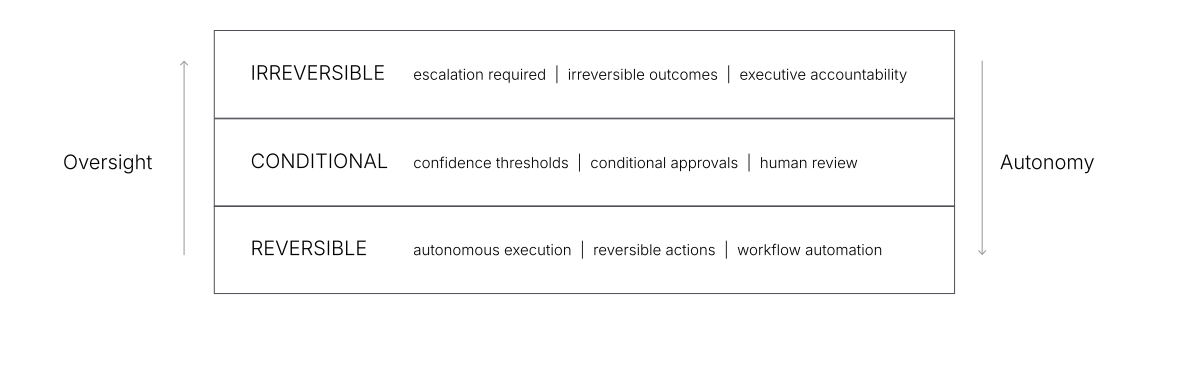
Enterprise AI governance model showing escalation, reversibility, oversight, autonomy, and operational risk boundaries for AI systems
Not all operational actions carry the same level of risk, consequence, or reversibility.

Systems that cannot distinguish between reversible and irreversible actions introduce unnecessary organizational risk. Oversight should increase alongside consequence, allowing low-risk execution to remain fluid while preserving escalation pathways for higher-impact decisions.

As AI systems become more autonomous, organizations increasingly redefine:
  • which actions can execute independently
  • where escalation becomes necessary
  • how intervention structures are introduced
  • which decisions remain reversible
  • how accountability persists across workflows

Operational control cannot remain static while execution capabilities continue to expand across connected systems and workflows.
Operational control must scale alongside autonomous execution

Accountability Systems

Visibility Across Execution

Responsibilities, escalation paths, and intervention boundaries cannot remain ambiguous once AI participates operationally.
Trust emerges through visibility, traceability, reversibility, and accountability continuity.
As autonomous participation expands, governance structures must scale alongside execution capability.
Operational trust emerges when autonomous execution remains governable at scale.